Corey Knutson

About

Corey Knutson is a Research Engineer at Honeywell Aerospace where he applies his diverse background in land, water, and space autonomous systems to improve alternative navigation systems for aircraft in GPS denied environments. Corey received his MS in Computer Science at the University of Minnesota - Twin Cities, where he was a member of the Interactive Robotics and Vision Lab and completed multiple research projects and publications in the area of sustainable autonomy for underwater robotic systems. Before grad school, Corey obtained his undergraduate degree in Computer Science at the University of Minnesota - Duluth, with a minor in Electrical Engineering.

Links

Simulations & Analysis Toolbox - A collection of interactive browser-based tools for controls simulation and data analysis

Publications

Honeywell’s QUEST-Driven Advancements in MagNav for Resilient GNSS-Independent Positioning

Hunter Staack, Corey Knutson, Calvin Samborski, Imraan Mitha, Sadman Sakib Enan, Trevor Stephens, Honeywell Aerospace Technologies
Abstract. Joint Navigation Conference (JNC) ION, 2026, Cincinnati, OH, USA. Available: https://www.ion.org/jnc/abstracts.cfm?paperID=16592

Abstract

Honeywell Alternative Navigation Architecture: Demonstrated Resiliency of Multi-Modality PNT in GNSS Contested Environments

Andrea Walker, Kevin Sweeney, Derrick Johnson, Corey Knutson, Brian Schipper, Honeywell Aerospace
Abstract. Joint Navigation Conference (JNC) ION, 2026, Cincinnati, OH, USA. Available: https://www.ion.org/jnc/abstracts.cfm?paperID=16645

Abstract

Design and Development of the MeCO Open-Source Autonomous Underwater Vehicle

David Widhalm, Cory Ohnsted, Corey Knutson, Demetrious Kutzke, Sakshi Singh, Rishi Mukherjee, Grant Schwidder, Ying-Kun Wu, Junaed Sattar
Proceedings of the IEEE/RSJ International Conference Intelligent Robots and Systems (IROS2025), Hangzhou, China. October 2025, Pages. 5315-5322, doi: 10.1109/IROS60139.2025.11247179.

PDF

Adaptive Landmark Color for AUV Docking in Visually Dynamic Environments

Corey Knutson, Zhipeng Cao, and Junaed Sattar
Proceedings of the IEEE International Conference on Robotics and Automation (ICRA), Yokohama, Japan, 2024, Pages 9990-9996, doi: 10.1109/ICRA57147.2024.10611083.

PDF

OpenMIND: Planning and Adapting in Domains with Novelty

D. J. Musliner, M. J. S. Pelican, M. McLure, S. Johnston, R. G. Freedman, and C. Knutson
Proceedings of the Ninth Annual Conference on Advances in Cognitive Systems, November 2021.

PDF

Evaluating Gin Rummy Hands Using Opponent Modeling and Myopic Meld Distance

P. Goldman, C. R. Knutson, R. Mahtab, J. Maloney, J. B. Mueller, and R. G. Freedman
Proceedings of the AAAI Conference on Artificial Intelligence, vol. 35, no. 17, pp. 15510–15517, May 2021.

PDF

Design and Experiments with LoCO AUV: A Low Cost Open-Source Autonomous Underwater Vehicle

Chelsey Edge, Sadman Sakib Enan, Michael Fulton, Jungseok Hong, Jiawei Mo, Kimberly Barthelemy, Hunter Bashaw, Berik Kallevig, Corey Knutson, Kevin Orpen, Junaed Sattar
*All authors contributed equally and are listed in alphabetical order according to surname.
Proceedings of the 2020 IEEE/RSJ International Conference on Intelligent Robots and Systems (IROS 2020).

PDF

Projects

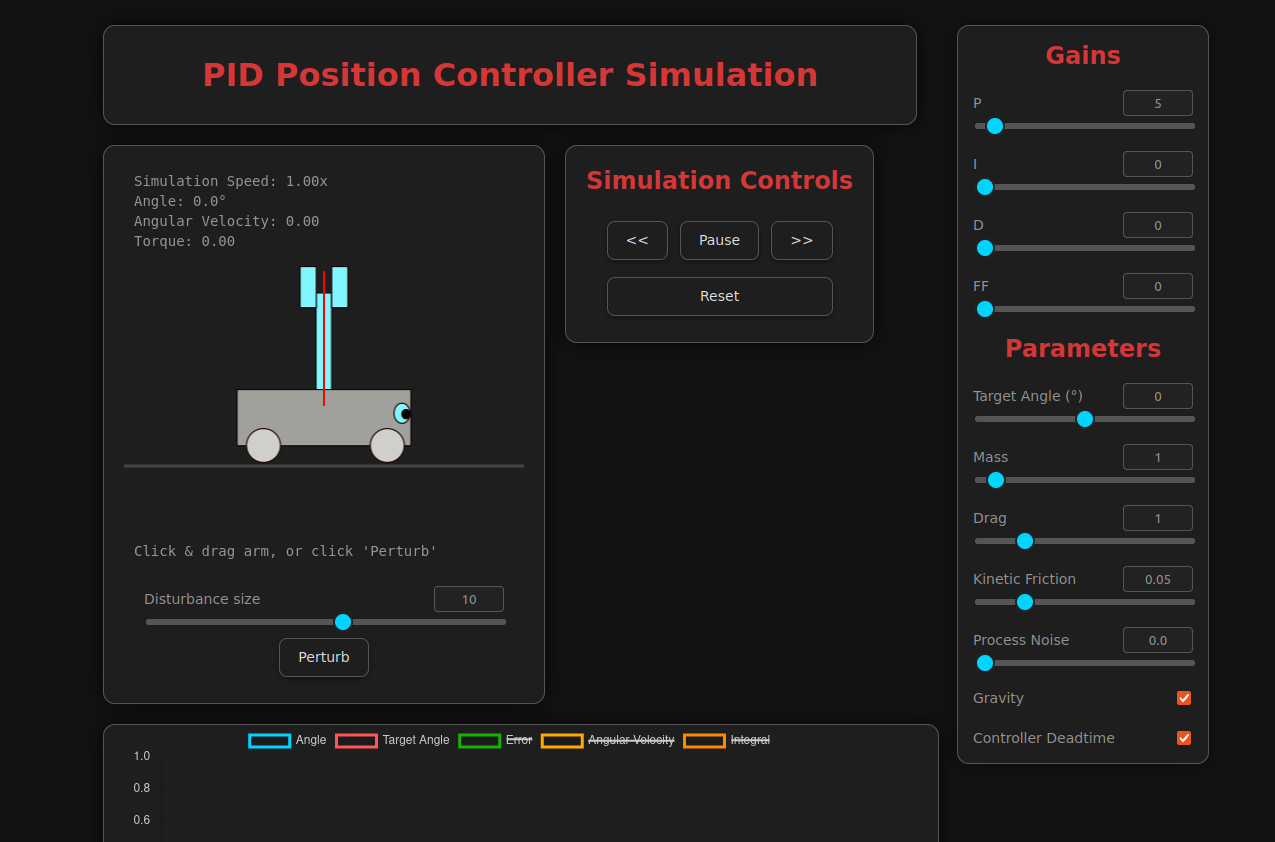
Online PID Position Controller Simulator

This highly realistic free online tool simulates a proportional integral derivative (PID) controller to move a robot arm to a desired angle. Parameterized environmental effects include gravity, drag, kinetic friction, controller deadtime, and more. A realtime plot of the arm angle helps visualize controller phenomenon.

Online PID Position Controller Simulator | Simulations & Analysis Toolbox
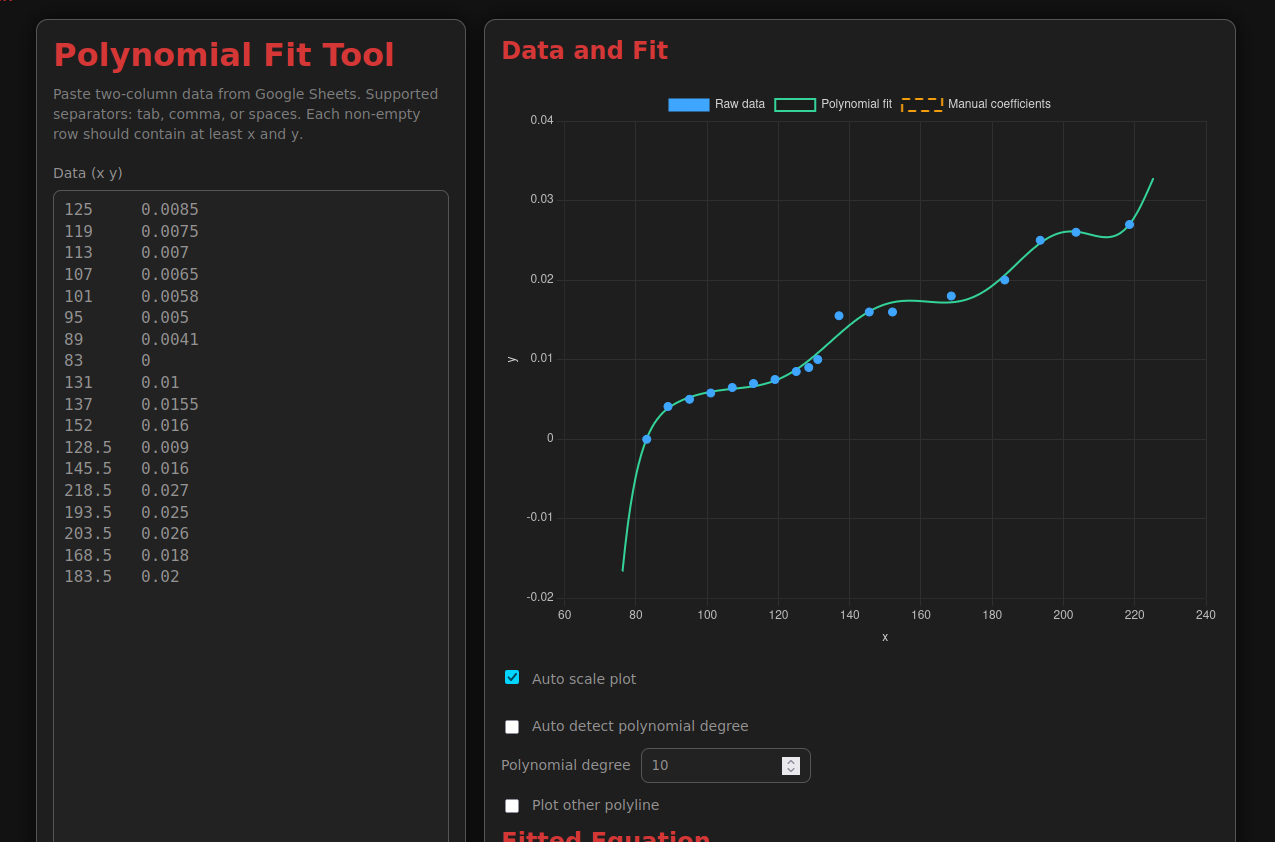
Polynomial Curve Fitting Tool

A browser-based least-squares polynomial regression tool for 2D data. Paste directly from Google Sheets, choose any polynomial degree, and the fitted equation updates automatically as you edit. Includes optional Java/C++/Python function snippet generation and an interactive plot of raw data with fitted curve.

Polynomial Curve Fitting Tool | Simulations & Analysis Toolbox
Bookend

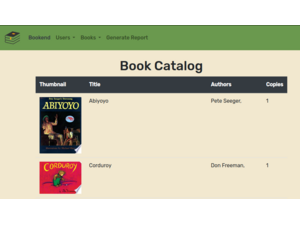
Bookend is an electronic library management tool aimed to make classroom library management easier for elementary school educators. Teachers typically have hundreds of books in their library, with many books lent out to their students at a time. Some teachers use spreadsheets to keep track of their library, but constantly updating a spreadsheet is time-consuming and can lead to confusion.

Students can easily check in and out books with a library card and barcode scanner using an accessible interface. Teachers can add new books with a barcode scanner, add students, import books from a .csv file, view books checked out to students, and much more.

This software was created as part of the Minnehack 2023 Hackathon
Demo Site | GitHub

LoCO AUV

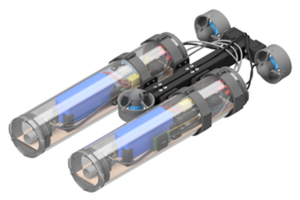
LoCO AUV is a Low-Cost Open-source Autonomous Underwater Vehicle (AUV) designed to perform research in marine environments.
Corey helped design and build LoCO as part of a summer Research Experience for Undergraduates (REU) program (see Experience).
Notable features include hardware synced cameras in each tube providing stereo imaging which is processed in realtime using the on-board NVIDIA Jetson TX2 SoC. Additionally, LED "eyes" and an upward facing OLED display enable robot-human interaction. Numerous research projects at the IRVLab at the University of Minnesota have utilized LoCO, including:
  • Diver following
  • Diver recognition and reidentification
  • Trash detection
  • Underwater image enhancement
  • View Project Poster | GitHub

    PCGCTF

    Procedural Content Generation for Capture The Flag Competitions (PCGCTF) is a complete system designed to train users on how to test the security of computer systems. Capture the Flag (CTF) games are popular in the computer security community and teach players how to break into a computer system in order to capture secret information. Players must gather data and analyze a system for potential exploits, execute the exploit, then exfiltrate the secret information.
    CTF games are typically hand-crafted due to their complexity. However, PCGCTF utilizes procedural content generation techniques to generate a CTF game automatically with varying difficulties and exploits. Corey was awarded an Undergraduate Research Opportunity (UROP) project at UMD, where he built the system and ran experiments with a dozen participants in order to test the effectiveness of PCGCTF as a teaching tool.
    Air Force Research Labs Senior Design Project

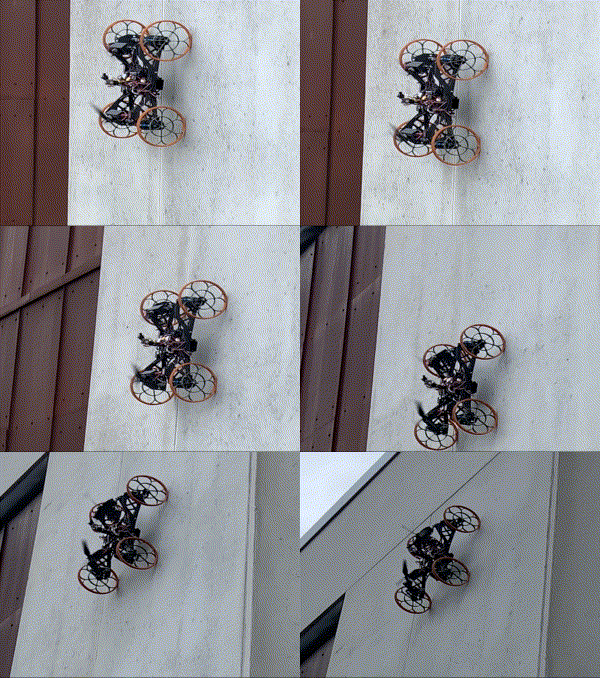
    The Air Force Research Labs (AFRL) holds a university design competition each year to design and build a system to solve a specific task. Corey opted to join UMD's Senior Design Project team competing in this design challenge and helped build the wall-climbing Sensor Deployment Rover. A total of nine students and four faculty members worked on this semester-long project and presented their report to AFRL members at the end of the semester.
    Corey's main contribution was designing and programming the software control stack, which included developing:
  • Ground-to-wall transition capabilities
  • An automatic thrust-vectoring control module
  • An integration for the military's ATAK situational awareness app
  • Gin Rummy Card Playing AI

    During his time at SIFT, Corey worked with a few of his fellow interns to create an AI to compete in the Gin Rummy EAAI Undergraduate Research Challenge.
    AI researchers have studied games like poker and chess, but the card game Gin Rummy has been largely untouched. The objective of the EAAI research challenge is to engage undergraduate students in the research life-cycle, from research and testing to publication and presentation.

    Corey's prior knowledge of Gin Rummy aided his contributions to the project, which included formulation of playing strategies of the agent, agent testing, and a written portion of the paper submission to EAAI.

    See "Publications" for paper.

    Experience

    Research & Design Engineer / Scientist

    Honeywell Aerospace

    Researching, designing, and testing alternative navigation technologies for aircraft in GPS denied environments using magnetic anomaly aided navigation. Notable work includes:

  • Enhancing legacy extended Kalman filter capabilities with efficient data structures and processing logic. Significantly increased solution stability and SITL replay capabilities.
  • Sole individual contributor porting legacy navigation capabilities to a MOSA EKF solution.
  • Led aircraft ground surveys for alternative navigation technologies, coordinating with FTEs, test pilots, and ground crew.
  • Perception Engineer Intern

    Astrobotic Technologies

    Supported LiDAR hazard detection C++ flight code development for the Griffin Mission 1 lunar lander. At the end of the 12 week internship, deliverables included:

  • Enhanced robustness of LiDAR data processing C++ flight code through test-driven development practices. 3 existing bugs discovered and resolved. Increased code test coverage of various LiDAR flight software components by 75%.
  • Improved linear algebra frame transformations and spatial outlier rejection methods ofthe LiDAR data processing module. 10 pull requests merged in 12 weeks.
  • Decoupled algorithmic components from data streaming logic using standard design patterns. Added support for temporally varying data packets, standardized exceptions and guarantees for functions manipulating the scan data, and improved time and space complexities of existing data operations.
  • A new high fidelity physics-based LiDAR scan simulator written in Python. Functionality based on vendor ICD and in-house testing of the LiDAR. This tool is now used for Monte Carlo simulations for 3 projects within the company.
  • Teaching Assistant

    University of Minnesota - Twin Cities

    Developed and taught lessons for CS undergraduate capstone and writing intensive class Software Design and Development. Specific duties included:

  • Adding functionality to a base C++ drone simulation software backend for vision recognition using OpenCV which students used in various assignments and projects.
  • Running technical lab sessions, teaching students about Git/GitHub, Docker, Agile/Scrum, design patterns, and adding functionality to a simulation written in C++.
  • Creating and grading assignments covering software design specifications, polymorphism, inheritance, abstraction, path planning, UML class diagrams, code quality, and design patterns.
  • Software Research Intern

    SIFT (Smart Information Flow Technologies)

    SIFT is a research company based in Minneapolis, MN, focused on AI and human factors research. Corey interned at SIFT for two summers and assisted with software research and development for a variety of government contracts. Corey also received the Company Hard Worker Award for his contributions to various projects.
    Specific deliverables included

  • Implemented object recognition and control for a robotic platform in first 2 weeks, recorded a demo for the customer.
  • Integrated an AI agent into domain novelty simulations ScienceBirds and DoomViz for testing and validation. Utilized rabbitmq and Docker compose to orchestrate simulation episodes and inter-agent communication.
  • Identified and patched a non-deterministic bug in the open source fuzzing tool afl.

  • Computer Repair Technician

    University of Minnesota - UMD ITSS

    Performed various PC and Mac computer repairs, including data recoveries, component replacement, and malware removal.

  • Apple Certified Mac Technician
  • Undergraduate Research Assistant

    University of Minnesota - Twin Cities

    The University of Minnesota's Interactive Robotics and Vision Lab is the home of the Minnesota Robotics Institute and the state's premier facility for underwater robotics and vision research. Corey spent his summer at the IRV Lab participating in a Research Experience for Undergraduates (REU) program where he worked with professors and PhD students to develop a new underwater robot called LoCO. Specific contributions included

  • Designing and fabricating the power and communication harnesses
  • Waterproofing cable ingress locations
  • Developing the teleoperation software stack using ROS
  • Performing field tests
  • Education

    University of Minnesota - Twin Cities

    August 2021 - December 2023

    Master of Science, Computer Science

    Projects: Autonomous Underwater Vehicle (AUV) surface docking station design, visual detection, and control. Medium-Cost Open (MeCO) AUV compute architecture and software design. AUV surface attitude control.

    Participated in and led over 50 field experiments in pools, lakes, rivers, research labs, and oceans. Collaborated with departments and organizations within/outside the university for research and demonstrations. Teleoperated 6 robots and sensors from the shore and in the water.

    Honors: Gauge Fellowship

    University of Minnesota - Duluth

    August 2017 - May 2021

    Bachelor of Science in Computer Science

    Minor: Electrical Engineering | GPA: 3.9/4.0
    Honors: Dean's List, CS Department Outstanding Senior Award, UMD Academic
    Scholarship, CS Department Scholarship

    Skills

    Get in Touch